

 Image 1 of 5
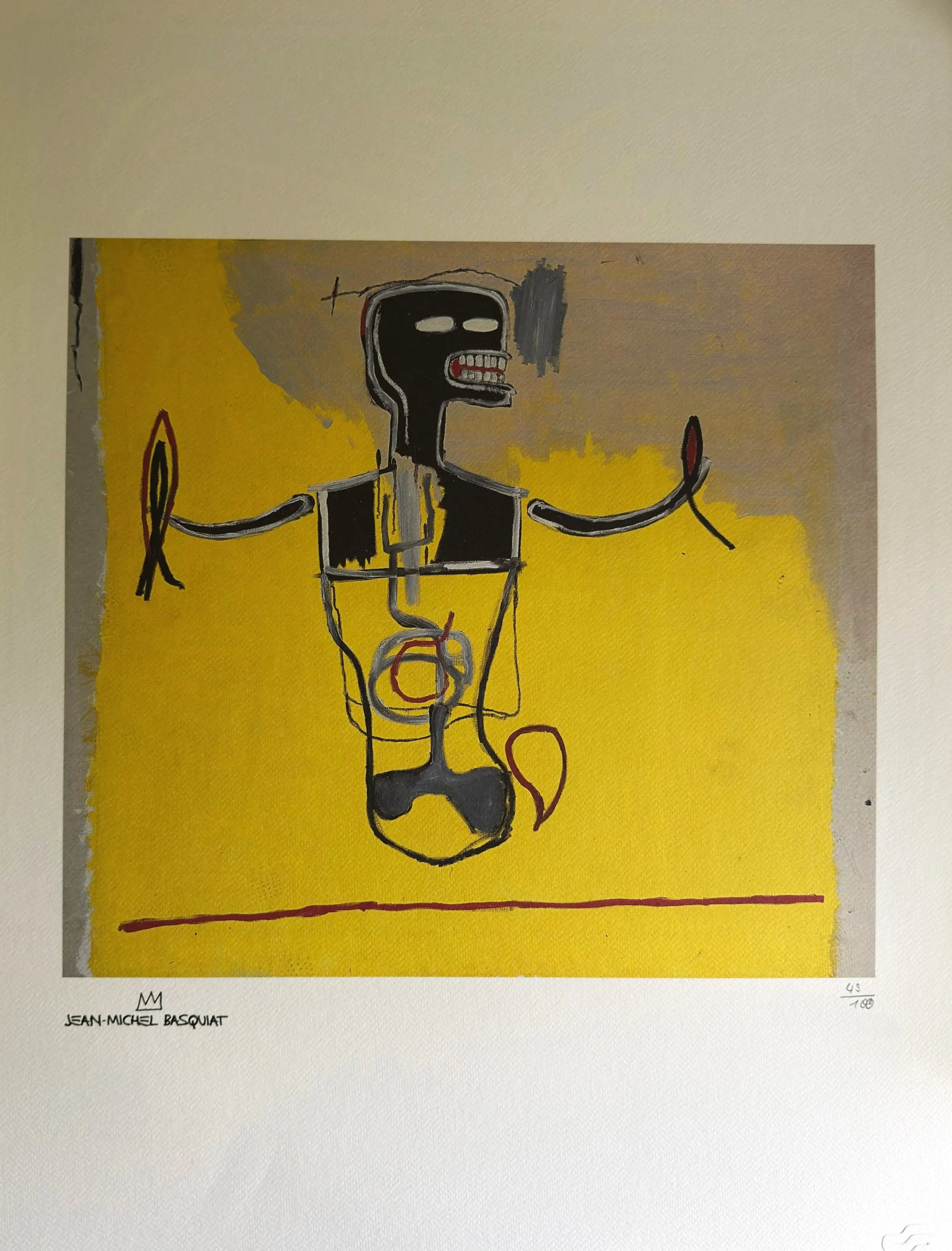 Image 2 of 5
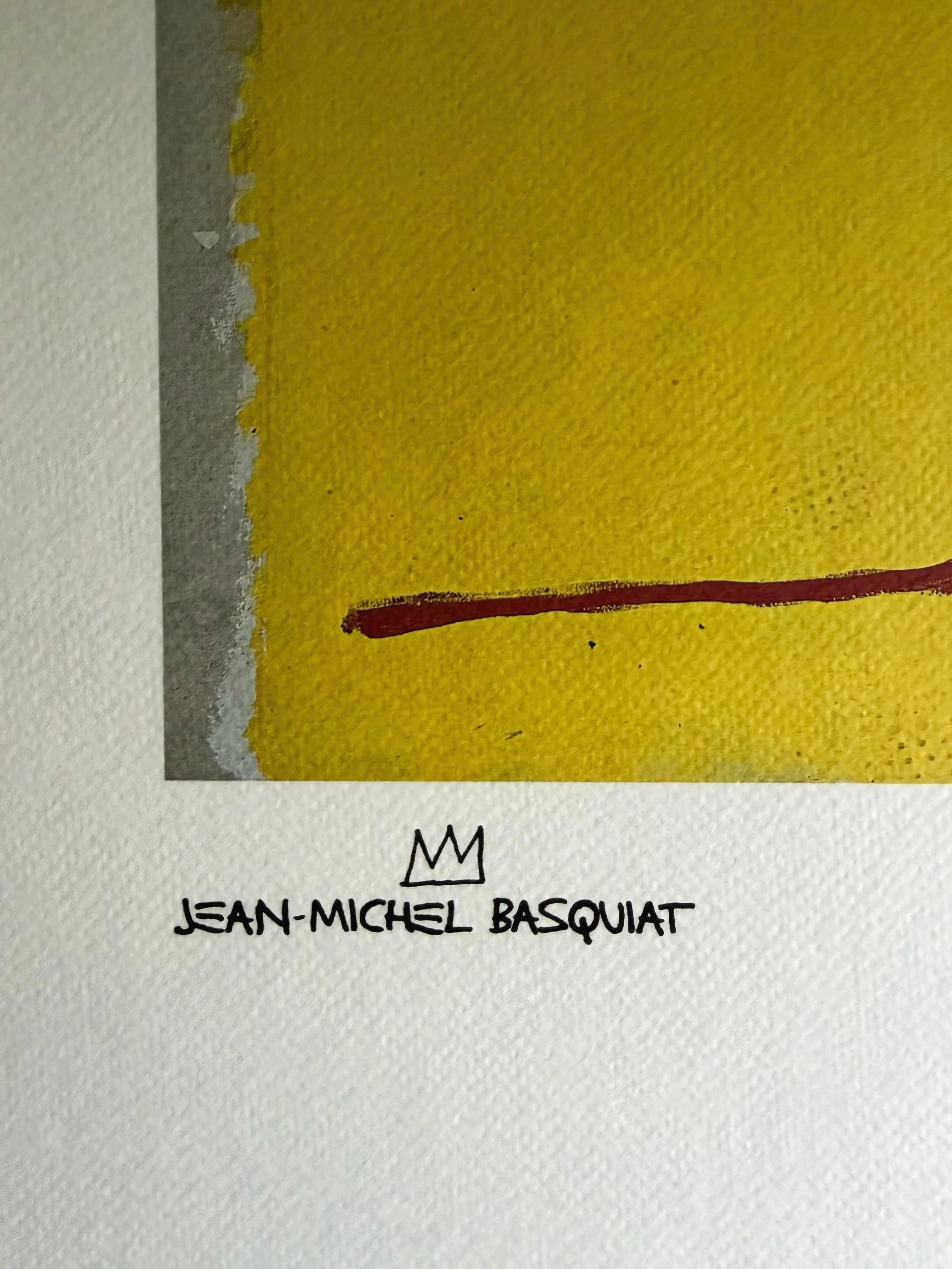 Image 3 of 5
 Image 4 of 5
 Image 5 of 5

Deconstructing 'Spike'
The 1984 Narrative Shift: From Cacophony to Clarity By 1984, Basquiat had transitioned away from the dense, overcrowded compositions of his early career toward a "subtle economy of means." As noted by Jeffrey Deitch, Spike demonstrates an increasing sophistication where the artist penetrates the surface to focus on essential, resonating forms. This newfound clarity was fueled by an unprecedented streak of professional success—including 17 group exhibitions and his historic inclusion in the Whitney Biennial—allowing Basquiat to wield a more "analytical and discerning" symbolic formula.
A Synthesis of the Sacred and the ProfaneSpike functions as a complex semiotic matrix, blending the ritualism of African tribal art with the iconography of Western Catholicism. The figure is arranged in a central cruciform, with outstretched arms that morph into the Christian insignia of the fish—a "wobbly generic pantheon of saints" that elevates black cultural figures to the status of icons. Whether the title refers to the burgeoning filmmaker Spike Lee or Basquiat’s own signature hairstyle, the work serves as a "talismanic" bridge between urban identity and ancient spiritual traditions.
Anatomy of a Survivor: The 'Gray’s Anatomy' Influence The black-and-white, X-ray-like elements in Spike are a direct result of Basquiat’s childhood fascination with Gray’s Anatomy, a book given to him by his mother following a near-fatal car accident at age seven. The red, teardrop-shaped organ placed outside the body boundary is often interpreted as a reference to the splenectomy he underwent after the crash. This obsession with "inner vs. outer experience" allows the work to transcend mere portraiture, becoming a haunting, archaeological examination of his own corporeality.
The Tricolor of Identity: The Pan-African Palette The stark color palette of black, red, and yellow is more than an aesthetic choice; it is a powerful allusion to the African Diaspora. Mirrored in the Ugandan flag, these colors represent the people, their blood, and the native sunshine. Against the "vast field of cadmium yellow," the figure of Spike stands as a monumental statement on racial inequality and self-discovery within a white-dominated art world, masterfully scrutinizing the language of modernism from a unique racial vantage point.
Essential Insights: Basquiat’s 'Spike' (1984)
Peak Maturity: Executed at age 24, this work represents the exact moment Basquiat reached full artistic maturity, trading chaotic energy for "distilled color and heightened conviction."
Autobiographical Depth: Contains specific anatomical signifiers (the X-ray bones and red organ) that link the painting to Basquiat’s personal trauma and survival.
Blue-Chip Provenance: Part of the esteemed 1988 series printed by Rupert Jasen Smith on Lenox Museum Board, capturing the "breathtaking immediacy" of the original canvas.
Cultural Canonization: Represents Basquiat’s effort to add black heroes to the historical pantheon of art, potentially referencing the rise of filmmaker Spike Lee.