
 Image 1 of 5
 Image 2 of 5
 Image 3 of 5
 Image 4 of 5
 Image 5 of 5
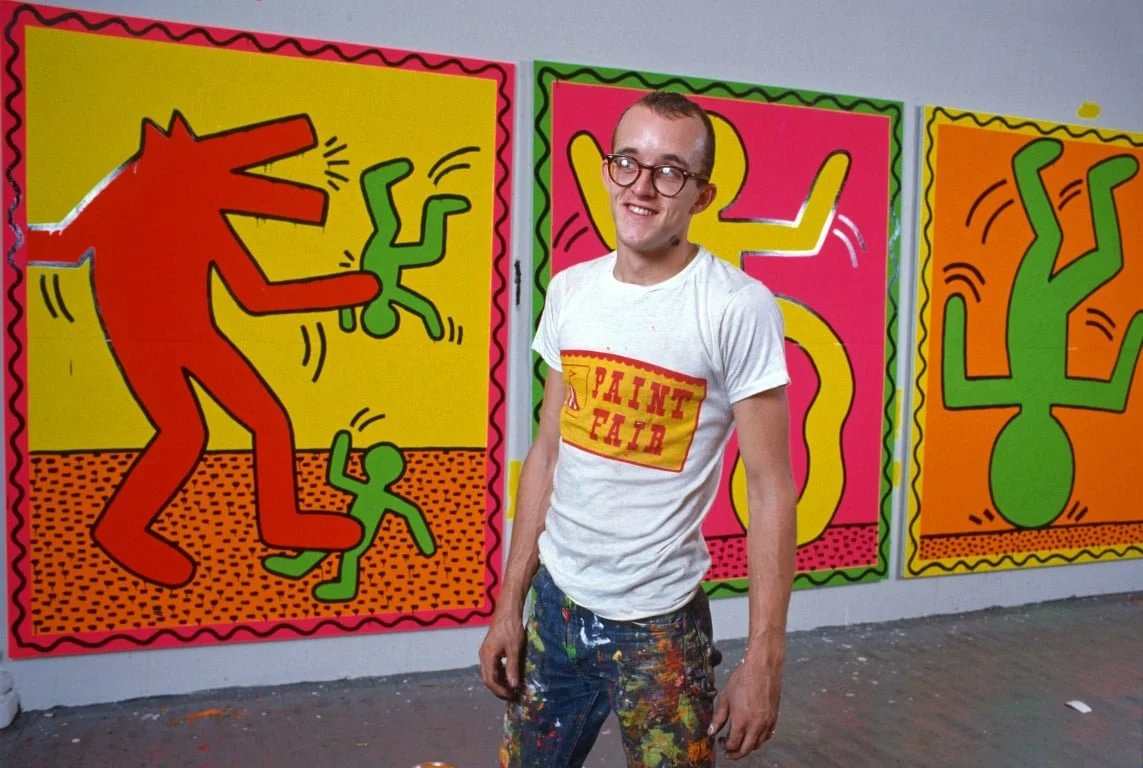
Keith Allen Haring (May 4, 1958 – February 16, 1990) was an American artist whose pop art emerged from the New York City graffiti subculture of the 1980s.[1] His animated imagery has "become a widely recognized visual language".[2] Much of his work includes sexual allusions that turned into social activism by using the images to advocate for safe sex and AIDS awareness.[3] In addition to solo gallery exhibitions, he participated in renowned national and international group shows such as documenta in Kassel, the Whitney Biennial in New York, the São Paulo Biennial, and the Venice Biennale. The Whitney Museum held a retrospective of his art in 1997.
Haring's popularity grew from his spontaneous drawings in New York City subways: chalk outlines of figures, dogs, and other stylized images on blank black advertising spaces.[4] After gaining public recognition, he created colorful larger scale murals, many commissioned.[4] He produced more than 50 public artworks between 1982 and 1989, many of them created voluntarily for hospitals, day care centers and schools. In 1986, he opened the Pop Shop as an extension of his work.
Early work: 1980–1981
Haring first received public attention with his graffiti art in subways, where he created white chalk drawings on black, unused advertisement boards in the stations.[20] He considered the subways to be his "laboratory," a place where he could experiment and create his artwork and saw the black advertisement paper as a free space and "the perfect place to draw".[21] The Radiant Baby, a crawling infant with emitting rays of light, became his most recognized symbol. He used it as his tag to sign his work while a subway artist.[12] Symbols and images (such as barking dogs, flying saucers, and large hearts) became common in his work and iconography. As a result, Haring's works spread quickly and he became increasingly more recognizable.
The cut-up technique in the writings of William S. Burroughs and Brion Gysin inspired Haring's work with lettering and words.[13] In 1980, he created headlines from word juxtaposition and attached hundreds to lamp-posts around Manhattan. These included phrases like "Reagan Slain by Hero Cop" and "Pope Killed for Freed Hostage".[22] That same year, as part of his participating in The Times Square Show with one of his earliest public projects, Haring altered a banner advertisement above a subway entrance in Times Square that showed a female embracing a male's legs, blacking-out the first letter so that it essentially read "hardón" instead of "Chardón," a French clothing brand.[23] He later used other forms of commercial material to spread his work and messages. This included mass-producing buttons and magnets to hand out and working on top of subway ads.
In 1980, Haring began organizing exhibitions at Club 57, which were filmed by his close friend, photographer Tseng Kwong Chi.[24] In February 1981, Haring had his first solo exhibition at Westbeth Painters Space in the West Village.[25][26] In November 1981, Hal Bromm Gallery in Tribeca presented the artist's first solo exhibition at a commercial gallery.[27]
Breakthrough and rise to fame: 1982–1986
In January 1982, Haring was the first of twelve artists organized by Public Art Fund to display work on the computer-animated Spectacolor billboard in Times Square.[28] That summer, Haring created his first major outdoor mural on the Houston Bowery Wall on the Lower East Side.[29] In his paintings, he often used lines to show energy and movement.[30] Haring would often work quickly, trying to create as much work as possible—sometimes completing as many as 40 paintings in a day.[19] One of his works, Untitled (1982), depicts two figures with a radiant heart-love motif, which critics have interpreted as a bold nod to homosexual love and a significant cultural statement.[30]
In 1982, Haring participated in documenta 7 in Kassel, where his works were exhibited alongside Joseph Beuys, Anselm Kiefer, Gerhard Richter, Cy Twombly, Jean-Michel Basquiat and Andy Warhol.[31] In October 1982, he had an exhibition at the Tony Shafrazi Gallery with his collaborator graffiti artist Angel "LA II" Ortiz.[32] That year, he was in several group exhibitions including Fast at the Alexander Milliken Gallery in New York.[33] Haring designed the poster for the 1983 Montreux Jazz Festival in Switzerland.[34]
In February 1983, Haring had a solo exhibition at the Fun Gallery in the East Village, Manhattan.[35] That year, Haring participated in the São Paulo Biennale in Brazil and the Whitney Biennial in New York.[36][37] In April 1983, Haring was commissioned to paint a mural, Construction Fence, at the construction site of the Haggerty Museum of Art in Milwaukee.[38] Later that year, Haring took part in the exhibition Urban Pulses: the Artist and the City in Pittsburgh by spray painting a room at the Pittsburgh Center for the Arts and creating an outdoor mural at PPG Place.[39] In October 1983, Elio Fiorucci invited Haring to Milan to paint the walls of his Fiorucci store.[40] While Haring was in London for the opening of his exhibition at the Robert Fraser Gallery in October 1983, he met and began collaborating with choreographer Bill T. Jones. Haring used Jones' body as the canvas to paint from head to toe.[41]
Haring and Angel "LA II" Ortiz produced a T-shirt design for friends Willi Smith and Laurie Mallet's clothing label WilliWear Productions in 1984.[42] After Haring was profiled in Paper magazine, fashion designer Vivienne Westwood reached out to editor-in-chief Kim Hastreiter to facilitate a meeting with Haring. Haring presented Westwood with two large sheets of drawings and she turned them into textiles for her Autumn/Winter 1983–84 Witches collection.[43][44] Haring's friend Madonna wore a skirt from the collection, most notably in the music video her 1984 single "Borderline."[45]
As Haring rose to stardom he continued to draw in the subways, contrasting the rocketing prices for his work.[46] Haring enjoyed giving his work away for free, often handing out free buttons and posters of his work.[46] In 1984, he released a book titled Art in Transit, which featured photography by Tseng Kwong Chi and an introduction by Henry Geldzahler.[47] Haring's swift rise to international celebrity status was covered by the media. His art covered the February 1984 issue of Vanity Fair, and he was featured in the October 1984 issue of Newsweek.[48][49] In July 1984, he painted singer Grace Jones for the first time for Interview magazine.[50]
In 1984, the New York City Department of Sanitation asked Haring to design a logo for their anti-litter campaign.[51] Haring participated in the Venice Biennale.[36] He was invited to create temporary murals at the National Gallery of Victoria and the Art Gallery of New South Wales.[52] During his visit to Australia, he painted the permanent Keith Haring Mural at Collingwood Technical College in Melbourne.[53] That year, Haring also painted murals at the Walker Art Center in Minneapolis and in Serra Grande, located in Bahia, Brazil.[54][55] Later that year, he designed the stage set for the production of Bill T. Jones and Arnie Zane's Secret Pastures at the Brooklyn Academy of Music.[56]
In 1985, Swatch introduced a line of watches designed by Haring.[57] Haring was commissioned by the United Nations to create a first day cover of the United Nations stamp and an accompanying limited edition lithograph to commemorate 1985 as International Youth Year.[58] He designed MTV set decorations and painted murals for various art institutions and nightclubs, such as the Palladium in Manhattan.[12] In March 1985, Haring painted the walls of the Grande Halle de la Villette for the Biennale de Paris.[59]
In July 1985, Haring made a painting for the Live Aid concert at J.F.K. Stadium in Philadelphia.[60] Additionally, he painted a car owned by art dealer Max Protetch to be auctioned, with proceeds donated to African famine relief.[61] Haring continued to be politically active as well by designing Free South Africa posters in 1985,[62] and creating a poster for the 1986 Great Peace March for Global Nuclear Disarmament.[63]
In December 1985, Haring painted The Ten Commandments to commemorate his first solo museum show at the CAPC musée d'art contemporain in Bordeaux.[64] Haring had a solo museum exhibition at the Stedelijk Museum in Amsterdam, and he painted a mural on the façade of the museum's storage building in March 1986.[65][66]
In June 1986, Haring created a 90-foot (27-metre) banner, CityKids Speak on Liberty, in conjunction with The CityKids Foundation to commemorate the centennial anniversary of the Statue of Liberty's arrival in the United States.[67] Later that month, he created his Crack Is Wack mural in East Harlem, visible from New York's FDR Drive.[15] It was originally considered as vandalism by the New York Police Department and Haring was arrested. But after local media outlets picked up the story, Haring was released on a lesser charge. While he was in jail, Haring's original work was vandalized to read "Crack Is It", then was overpainted by the Parks Department.[68] This mural is an example of Haring's use of consciousness raising rather than consumerism, "Crack is Wack" rather than "Coke is it."[69] He painted an updated version of the mural on the same wall in October 1986.[70]
In September 1986, Haring's permanent murals were unveiled at Woodhull Hospital in Brooklyn.[71][72]
He created a mural on the Berlin Wall for the Checkpoint Charlie Museum on October 23, 1986.[73] The mural was 300 meters (980 ft) long and depicted red and black interlocking human figures against a yellow background. The colors were a representation of the German flag and symbolized the hope of unity between East and West Germany.[74]
Haring painted a skirt for Grace Jones to wear in her music video "I'm Not Perfect (But I'm Perfect for You)" (1986) and he was the assistant director for the video.[75][76] He also body painted Jones for live performances at the Paradise Garage,[77] and for her role of Katrina the Queen of The Vampires in the 1986 film Vamp.[78] Haring collaborated with David Spada, a jewelry designer, to design the sculptural adornments for Jones.[79]
Haring collaborated with Warhol to design the poster for the 1986 Montreux Jazz Festival in Switzerland.[80] The poster was also used for the 1986 Montreux-Detroit Jazz Festival in Detroit.[80] He also designed a poster for Absolut Vodka, which was unveiled at the Whitney Museum in New York in October 1986.[81] In December 1986, while in Phoenix to meet with potential backers for a Haring-designed public playground, he led a drawing workshop at the Phoenix Art Museum, gave a lecture, and painted a mural with students downtown.[82][83]
Haring illustrated vinyl covers for various artists such as David Bowie's "Without You" (1983), N.Y.C. Peech Boys' Life Is Something Special (1983), Malcolm McLaren's "Duck For The Oyster" (1983), and Sylvester's "Someone Like You" (1986).[84]
Pop Shop
Main article: Pop Shop
In April 1986, Pop Shop opened in Soho, selling shirts, posters, and other items showcasing Haring's work.[85] This made Haring's work readily accessible to purchase at reasonable prices.[6] Having achieved what he wanted, which was "getting the work out to the public at large," Haring completely stopped drawing in the subways.[86] He also stopped because people were taking the subway drawings and selling them.[86]
Some criticized Haring for commercializing his work.[87][5] Asked about this, Haring said, "I could earn more money if I just painted a few things and jacked up the price. My shop is an extension of what I was doing in the subway stations, breaking down the barriers between high and low art."[6] The Pop Shop remained open after Haring's death until 2005, with profits benefiting the Keith Haring Foundation.[85]
The Pop Shop was not Haring's only effort to make his work widely accessible. Throughout his career, Haring made art in subways and on billboards.[6] His attempts to make his work relatable can also be seen in his figures' lack of discernable ages, races, or identities.[12] By the arrival of Pop Shop, his work had begun reflecting more socio-political themes, such as anti-Apartheid, AIDS awareness, and the crack cocaine epidemic.[5]
Final years and death: 1987–1990
He was diagnosed with HIV in 1987 and AIDS in the autumn of 1988.[89][90] He used his imagery during the last years of his life to speak about his illness and to generate activism and awareness about AIDS.[5]
The Boxers (1987) sculpture in Berlin
In 1987, Haring had exhibitions in Helsinki, Paris, and elsewhere. During his stay in Paris for the 10th anniversary exhibition of American artists at the Centre Georges Pompidou, Haring and his boyfriend Juan Rivera painted the Tower mural on an 88-foot-high (27 m) exterior stairwell at the Necker-Enfants Malades Hospital.[91][92] While in Belgium for his exhibition at Gallery 121, Haring painted a mural at the Museum of Contemporary Art, Antwerp.[93]
That same year, Haring was also invited by artist Roger Nellens to paint a mural at his Casino Knokke.[94] While working there, Haring stayed in Le Dragon, a monster-shaped guest house owned by Nellens which had been designed by artist Niki de Saint Phalle. With the consent of both the designer and the owner, Haring painted a fresco mural along an interior balcony and stairway.[95][96]
Haring designed a carousel for André Heller's Luna Luna, an ephemeral amusement park in Hamburg from June to August 1987 with rides designed by renowned contemporary artists.[97][98] In August 1987, Haring painted a large mural at the Carmine Street Recreation Center's outdoor pool in the West Village.[99][100] In September 1987, he painted a temporary mural, Detroit Notes, at the Cranbrook Art Museum in Bloomfield Hills, Michigan. The work reveals a darker phase in Haring's style, which Cranbrook Art Museum Director Andrew Blauvelt speculates foreshadowed the confirmation of his AIDS diagnosis.[101]
Haring designed the cover for the 1987 benefit album A Very Special Christmas and the Run-DMC single "Christmas In Hollis"; proceeds went to the Special Olympics.[58][84] The image for the A Very Special Christmas compilation album consists of a typical Haring figure holding a baby. Its "Jesus iconography" is considered unusual in modern rock holiday albums.[102]
Also in 1987, Haring painted a mural in the Philadelphia neighborhood of Point Breeze titled 'We the Youth' to commemorate the bicentennial of the United States Constitution. Originally intended as a placeholder, a new rowhouse was never built and the lot became a park. The mural underwent a major restoration in 2013 and is Haring's longest standing public mural at its original location.[103]
In 1988, Haring joined a select group of artists whose work has appeared on the label of Chateau Mouton Rothschild wine.[104] In January 1988, he traveled to Japan to open Pop Shop Tokyo; it closed in the summer of 1988.[105] Haring collaborated with his friend Stephen Sprouse on designing prints for his Fall 1988 collection.[106] Haring also painted Sprouse's Honda CBR1000F.[107][44]
In April 1988, Haring created a mural on the South Lawn for the annual White House Easter Egg Roll, which he donated to Children's National Hospital in Washington, D.C.[108] Late in the summer, Haring traveled to Düsseldorf for a show of his paintings and sculptures at the Hans Mayer Gallery.[109] In December 1988, Haring's exhibition opened at the Tony Shafrazi Gallery, which he stated was his most important show to date. He felt he had something to prove because of his health condition and the deaths of his friends Andy Warhol and Jean-Michel Basquiat.[110]
Todos Juntos Podemos Parar el SIDA (1989) in Barcelona, Spain
In February 1989, Haring painted the Todos Juntos Podemos Parar el SIDA mural in the Barrio Chino neighborhood of Barcelona to raise awareness of the AIDS epidemic.[111] In May 1989, at the invitation of a teacher named Irving Zucker, Haring visited Chicago to paint a 480-foot mural in Grant Park along with nearly 500 students.[112] Three other Haring murals materialized in Chicago around the same time: two at Rush University Medical Center, the other at Wells Community Academy High School.[113] The latter was completed days before Haring's arrival in Chicago, as a sort of welcome.[114] According to Zucker, Haring sent the school a design template for the mural, which was executed by a fellow teacher, Tony Abboreno, an abstract artist, and Wells High School art students, but Haring gave it his final approval and signed it himself.[114]
For The Center Show, an exhibition celebrating the 20th anniversary of the Stonewall Riots, Haring was invited by the Lesbian and Gay Community Services Center in New York to create a site-specific work.[115] He chose the second-floor men's bathroom to paint his Once Upon a Time... mural in May 1989.[116] In June 1989, Haring painted his Tuttomondo mural on the rear wall of the convent of the Sant'Antonio Abate church in Pisa.[117] Haring criticized the avoidance of social issues such as AIDS through a piece called Rebel with Many Causes (1989) that revolves around the theme of "hear no evil, see no evil, speak no evil".[118]
During the last week of November 1989, Haring painted a mural at the ArtCenter College of Design in Pasadena for "A Day Without Art". The mural was commemorated on December 1, the second annual AIDS Awareness Day. He commemorated the mural on December 1, World AIDS Day, and told the Los Angeles Times: "My life is my art, it's intertwined. When AIDS became a reality in terms of my life, it started becoming a subject in my paintings. The more it affected my life the more it affected my work."[5] From Pasadena, Haring flew to Atlanta for the opening of his dual show with photographer Herb Ritts at the Fay Gold Gallery on December 2.[119]
In 1990, Haring painted a BMW Z1 at the Hans Mayer Gallery in Düsseldorf.[120][121] He traveled to Paris for what would be his last exhibition, Keith Haring 1983, at Galerie 1900–2000/La Galerie de Poche in January 1990.[122][123]
Just two weeks before his death, Haring completed The Life of Christ, a triptych carved in clay and cast in nine bronze editions, each finished with a white-gold patina.[124] There are nine versions of the triptych in total: one is installed in the Saint-Eustache Church in Paris, and another at the Cathedral of St. John the Divine in Manhattan.[125]
On February 16, 1990, Haring died of AIDS-related complications at his LaGuardia Place apartment in Greenwich Village.[126][6] He was cremated and his ashes were scattered in a field near Bowers, Pennsylvania, just south of his hometown of Kutztown.[127]
On May 4, 1990, which would have been Haring's 32nd birthday, a memorial service was held at the Cathedral of St. John the Divine in Manhattan.[128] Speakers included Mayor David N. Dinkins, actor Dennis Hopper, soprano Jessye Norman, ballet dancers Heather Watts and Jock Soto, and former Parks Commissioner Henry Stern.[128] "He was a man whose short life was a mission of life and hope," said Dinkins, for whom Haring had designed campaign materials.[128] "Rarely has a person in his position given so much of himself to other human beings… his whirlwind philanthropy stands out even in a city known for philanthropy."[128]
Works
Social activism
Haring's work was closely tied to his commitment to social and political activism, which became a defining aspect of his career throughout the 1980s. He used his public visibility and distinctive graphic style to address issues including the crack epidemic, LGBTQ rights, and the growing HIV/AIDS crisis. He created works promoting literacy and youth engagement in collaboration with public schools and community organizations.
Haring was an outspoken critic of apartheid, most notably creating the poster Free South Africa (1985), which became widely reproduced symbols of protest.[129]
He also produced works supporting nuclear disarmament. An example of this is a black and white striped flag that he said symbolized the danger of a nuclear apocalypse.[12] In some of his art he drew connections between the end of the world and the AIDS virus. In a piece that he made with William Burroughs, he depicts the virus as demon-like creatures, the number 666, and a mushroom cloud.[12]
As a gay artist who was diagnosed with AIDS in 1988, Haring became an important public advocate for AIDS awareness and education. In 1989, he established the Keith Haring Foundation to provide funding to AIDS organizations and children's programs, as well as to maintain and distribute his artwork.[130]
During the final year of his life, he intensified his activism, participating in campaigns such as ACT UP initiatives and creating imagery used by advocacy groups to destigmatize the disease.[131] His work Silence=Death, which mirrors the ACT UP poster and uses its motto, is almost universally agreed upon as a work of HIV/AIDS activism.[132] In 1989, Haring designed T-shirts to commemorate the 20th anniversary of the Stonewall riots.[133]
Three months after his death, Haring posthumously appeared in Rosa von Praunheim's documentary film Silence = Death (1990) about gay artists in New York City fighting for the rights of people with AIDS.[134]
Exhibitions
From 1982 to 1989, Haring was featured in more than 100 solo and group exhibitions and produced more than 50 public artworks for charities, hospitals, day care centers, and orphanages.[135] He was represented by well-known galleries such as the Tony Shafrazi Gallery and the Leo Castelli Gallery.[136] Since his death, has been featured in over 150 exhibitions around the world.[137] He has also been the subject of several international retrospectives.
Haring had his first solo exhibition at Westbeth Painters Space in February 1981.[25][26] That month he also participated in New York/New Wave exhibit at MoMA PS1.[138] Later that year he had a solo exhibition in the Hal Bromm Gallery,[139] followed by his breakthrough exhibition at the Tony Shafrazi Gallery in 1982.[140] That same year, he took part in documenta 7 in Kassel as well as Public Art Fund's Messages to the Public series in which he created work for a Spectacolor billboard in Times Square.[12] In 1983, Haring contributed work to the Whitney Biennial and the São Paulo Biennial. He also had solo exhibitions at the Fun Gallery, Galerie Watari in Tokyo, and his second show the Tony Shafrazi Gallery.[141][142][35]
In 1984, Haring participated in the group show Arte di Frontiera: New York Graffiti in Italy.[143] He participated in the Venice Biennale in 1984 and 1986.[144][36] In 1985, Haring took part in the Paris Biennial and he had his first solo museum exhibition at the CAPC musée d'art contemporain in Bordeaux.[145][3] In 1986, three of Haring's sculptures were placed at Dag Hammarskjöld Plaza outside the United Nations headquarters.[146][99] Two of the works were displayed at Riverside Park from May 1988 to May 1989.[99] In 1991–92, Haring's Figure Balancing on Dog was displayed in Dante Park in Manhattan.[99]
In 1996, a retrospective at the Museum of Contemporary Art Australia was the first major exhibition of his work in Australia. His art was the subject of a 1997 retrospective at the Whitney Museum of American Art in New York, curated by Elisabeth Sussman.[147] The Public Art Fund, in collaboration with the Estate of Keith Haring, organized a multi-site installation of his outdoor sculptures at Central Park's Doris C. Freedman Plaza and along the Park Avenue Malls.[148] This public exhibition occurred simultaneously with the retrospective at the Whitney.[149] The sculptures later traveled to the West Coast in 1998. The San Francisco Arts Commission displayed 10 sculptures around San Francisco to coincide with Haring's retrospective at the San Francisco Museum of Modern Art.[150] The city of West Hollywood and Haring's estate also presented his sculptures on Santa Monica Boulevard.[151]
In 2007, Haring's painted aluminum sculpture Self-Portrait (1989) was displayed in the lobby of the Arsenal in Central Park, as part of the retrospective exhibition The Outdoor Gallery: 40 Years of Public Art in New York City Parks.[99]
In 2008, there was a retrospective exhibition at the MAC in Lyon, France. In February 2010, on the occasion of the 20th anniversary of the Haring's death, the Tony Shafrazi Gallery showed an exhibition containing dozens of works from every stage of Haring's career.[152] In March 2012, a retrospective exhibit of his work, Keith Haring: 1978–1982, opened at the Brooklyn Museum in New York.[153] In April 2013, the retrospective Keith Haring: The Political Line opened at the Musée d'Art Moderne de la Ville de Paris and Le Cent Quatre. In November 2014, then at the De Young Museum in San Francisco.[154]
From December 2016 to June 2017, the Petersen Automotive Museum in Los Angeles exhibited The Unconventional Canvases of Keith Haring, which featured five vehicles that Haring painted.[155] In 2019, Haring's work was exhibited at Gladstone Gallery in Belgium and the New York Law School in Manhattan.[156][157] The first major UK exhibition of Haring's work, featuring more than 85 artworks, was at Tate Liverpool from June to November 2019.[158] From December 2019 to March 2020, the National Gallery of Victoria in Melbourne exhibited Keith Haring and Jean-Michel Basquiat: Crossing Lines.[159]
In 2021, the Museum of Contemporary Art Denver displayed the exhibition Keith Haring: Grace House Mural, which consisted of 13 panels from a mural Haring painted at a Catholic youth center on the Upper West Side of Manhattan in either March 1983 or 1984.[160] The mural—which featured Haring's radiant baby, barking dog, and dancing man figures—spanned three floors and 85 feet. When Grace House was sold, its operator, the Church of the Ascension, went against the Keith Haring Foundation's wishes of securing a buyer who would maintain the work. Instead, the church had sections of the mural cut out and sold at auction in 2019 to an anonymous private collector for $3.86 million.
In 2022, the exhibition Keith Haring: Grace House Mural was displayed at the Schunck Museum in Heerlen.[161] In 2023, The Broad presented Haring's first museum exhibition in Los Angeles, Keith Haring: Art is for Everyone.[162]
Art market
A CBS Evening News report from October 1982 shows scenes from Haring's solo exhibit at the Tony Shafrazi Gallery in SoHo. It was reported that over a quarter of a million dollars' worth of paintings were sold within the first few days of the show's opening.[163] Although he was an established artist by 1983, Shafrazi stated that Haring wanted to keep his prices low.[164] His prices ranged from $3,000 for a drawing to $15,000 for a large painting.[164] By 1984, his works were selling for up to $20,000 and he had an annual income of $250,000.[46][165]
Haring created the Pop Shop in 1986 in the SoHo district of Manhattan, selling T-shirts, toys, posters, and other objects that show his works—allowing his works to be accessible to a larger number of people.[87] Speaking about the Pop Shop in 1989, Haring said: "For the past five or six years, the rewards I've gotten are very disproportionate to what I deserve...I make a lot more money than what I should make, so it's a little bit of guilt, of wanting to give it back."[5]
Haring was represented until his death by art dealer Tony Shafrazi.[166] Since his death in 1990, his estate has been administered by the Keith Haring Foundation, which is represented by Gladstone Gallery.[167] In May 2017, Haring's painting Untitled (1982), which features his signature symbols—the radiant baby, barking dogs, angels and red Xs—sold for $6.5 million at Sotheby's in New York, becoming the most expensive Haring artwork sold at auction.[168] However, the winning bidder, Anatole Shagalov, failed to pay and Sotheby's resold it for $4.4 million in August 2017.[169]
In October 2020, the Keith Haring Foundation hired Sotheby's to hold an online auction of more than 140 works from Haring's collection.[170] Dear Keith surpassed its estimate of $1.4 million to achieve $4.6 million with a 100 percent sell-through rate by lot. All proceeds from the sale went to the Lesbian, Gay, Bisexual & Transgender Community Center of New York.[170] In December 2021, Haring's 1982 painting Untitled (Acrobats) from the collection of Peter M. Brant and Stephanie Seymour, sold for $5.5 million at Sotheby's in New York.[171]
In 2022, the drawing of ''Radiant Baby'' that he had made on the wall of his childhood home in the early 1980s was removed by its owners (together with part of the wall paneling) and offered for sale.[172]
Collections
Haring's work is in major private and public collections, including the Museum of Modern Art, the Morgan Library and Museum, and the Whitney Museum of American Art in New York City; Los Angeles County Museum of Art; the Art Institute of Chicago; the Bass Museum in Miami; Musée d'Art Moderne de la Ville de Paris; the Brant Foundation Art Study Center in Greenwich, Connecticut; the Carnegie Museum of Art and the Andy Warhol Museum in Pittsburgh; the Ludwig Museum in Cologne; and the Stedelijk Museum in Amsterdam.[173] He also created a wide variety of public works, including the infirmary at Children's Village in Dobbs Ferry, New York,[174] and the second floor men's room in the Lesbian, Gay, Bisexual & Transgender Community Center in Manhattan, which was later transformed into an office and is known as the Keith Haring Room.[175][176]
The Nakamura Keith Haring Collection, established in 2007 in Hokuto, Yamanashi, Japan, is an art museum exhibiting exclusively the artworks of Haring.[177][178]
The Keith Haring Foundation
In 1989, Haring established the Keith Haring Foundation to provide funding and imagery to AIDS organizations and children's programs. The foundation's stated goal is to keep his wishes and expand his legacy by providing grants and funding to non-profit organizations that educate disadvantaged youths and inform the public about HIV and AIDS. It also shares his work and contains information about his life.[130] The foundation also supports arts and educational institutions by funding exhibitions, educational programs, and publications.[130] In 2010, the foundation partnered with the AIDS Service Center NYC to open the Keith Haring ASC Harlem Center to provide HIV peer education and access to care services in Harlem.[213]